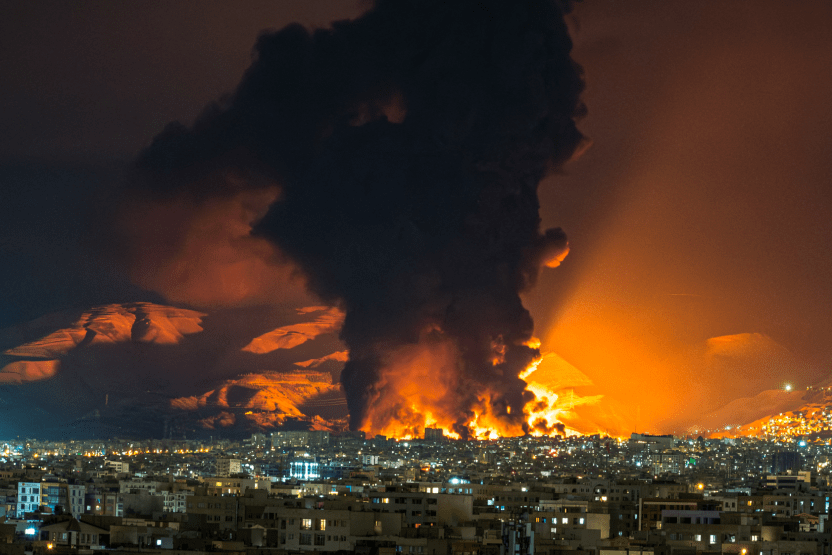
A new scientific study has revealed the extraordinary scale of pollution released by the March 2026 fires at Tehran's oil depots and refinery facilities, showing that toxic emissions spread across an area of nearly 300,000 square kilometers—roughly the size of Italy—and traveled thousands of kilometers beyond Iran's borders.
Published in the journal
Advances in Atmospheric Sciences, the research used a combination of Chinese and European satellites to track the movement of sulfur dioxide (SO₂) released during the fires. The scientists estimate that nearly 30,000 tonnes of the pollutant entered the atmosphere over a period of about two days, an amount comparable to emissions from a major industrial disaster or a medium-sized volcanic eruption.
What makes the findings particularly striking is the speed and distance over which the pollution traveled. According to the researchers, atmospheric currents carried the plume northeastward at rates approaching 200 kilometers in just three hours. Within two days, the contamination had crossed multiple national borders and reached East Asia.
The study highlights a reality often overlooked during wartime: environmental damage does not respect political frontiers. While the fires occurred in Tehran, their atmospheric consequences extended far beyond Iran, affecting air masses over Central Asia and eventually reaching regions thousands of kilometers away.
Scientists focused on sulfur dioxide because it is one of the most dangerous pollutants produced by large petroleum fires. The gas can irritate the respiratory system, worsen cardiovascular and pulmonary diseases, damage vegetation, and contribute to the formation of acid rain.
Researchers also point to reports of "black rain" following the fires—a mixture of soot, oil residues, and atmospheric pollutants generated by the combustion of petroleum products. Such pollution raises concerns not only for air quality but also for soils, vegetation, freshwater resources, and agricultural land exposed to pollutant fallout.
The environmental consequences may outlast the fires themselves. Although the atmospheric plume dispersed relatively quickly, pollutants deposited on the ground can remain in ecosystems for years, potentially entering food chains through crops, livestock, and water supplies.
Beyond documenting a major pollution event, the study also demonstrates the growing role of satellites in monitoring environmental crises during armed conflicts. Using observations from China's FengYun satellite system and Europe's Sentinel-5P mission, researchers were able to reconstruct the evolution of the pollution cloud almost in real time, despite the lack of extensive ground-based monitoring networks in the region.
The findings offer one of the clearest scientific pictures yet of the environmental footprint of the 2026 Iran war. They also serve as a reminder that when energy infrastructure burns, the consequences are rarely local. Winds can carry the toxic legacy of war across continents, transforming a national disaster into a regional environmental challenge.











Comment
Reply