



06 Jun 2026

Tired Earth
By The Editorial Board
Fossil fragments found in the U.K. have been identified as remains of the largest scorpions ever. Measuring more than a meter in length, Praearcturus gigas was among the first large predators to ever stalk the land.
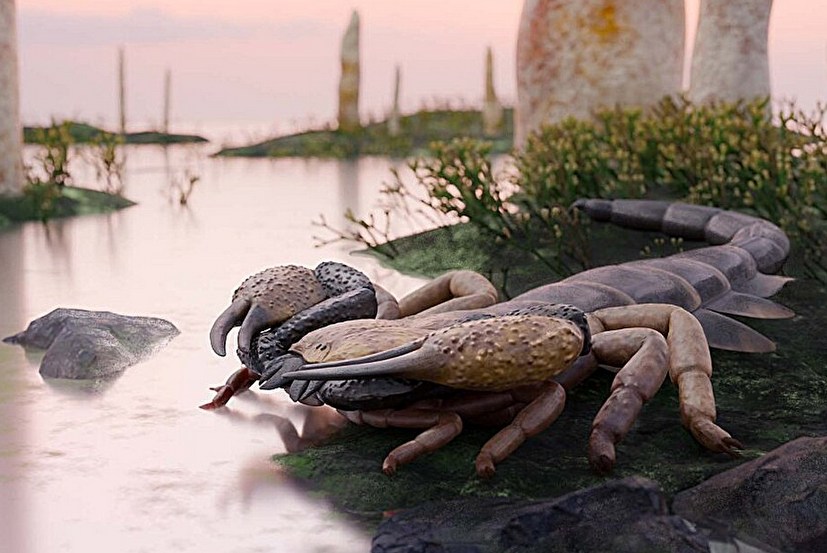
Fossil fragments found in the U.K. have been identified as remains of the largest scorpions ever. Measuring more than a meter in length, Praearcturus gigas was among the first large predators to ever stalk the land.
Hundreds of millions of years ago, England and Wales were home to the biggest scorpion in the world. While fossils of Praearcturus gigas have been known about for more than a century, its identity has been the subject of controversy. New research examining a range of fossils has now confirmed its status as one of the largest prehistoric scorpions.
With 16-centimeter-long pincers and an estimated body length of more than a meter, Praearcturus gigas would have towered over the floodplains 415 million years ago. Life on land was still fairly new during the Early Devonian Period, meaning few other animals would have reached such enormous sizes.
As a result, this giant scorpion would have had its pick of prey as it hunted small arthropods on land. But Praearcturus would likely have been a fearsome aquatic predator as well, feeding on fish and other large animals.
Dr. Richie Howard, the lead author of the study and our Curator of Fossil Arthropods, says that the presence of the biggest scorpion ever found so early in the history of life on land changes what we know about the evolution of these animals.
"When we think of giant arthropods, people tend to think of enormous millipedes like Arthropleura or the dragonfly-like griffinflies," Howard says. "But these species lived in the Carboniferous Period, at least 55 million years after Praearcturus, once land-based ecosystems had time to develop.
"Instead, Praearcturus lived when life on land was just starting out and the ancestors of reptiles, mammals and birds were yet to leave the water. It suggests that this species might have grown so big because there weren't any other large predators, allowing it to dominate its environment."
The findings of the study are published in the journal Palaeontology.

Arthropods, the phylum containing insects, scorpions, spiders and crustaceans, are the most diverse group of animals on Earth. Not only are they incredibly species rich, but they also have a wide range of sizes.
The smallest species, such as Stygotantulus stocki, are less than a millimeter long, while the largest arthropods are thousands of times bigger. The Japanese spider crab, for instance, measures almost 4 meters long when its limbs are fully stretched out.
Crustaceans and other aquatic species tend to be able to reach large sizes as water provides support for their bodies. In contrast, land-based arthropods such as the Indian forest scorpion are much smaller. Even though it is the living world's biggest scorpion, it only reaches a maximum length of about 23 centimeters.
When Praearcturus was first named by Henry Woodward in 1871, it was thought to be a giant woodlouse-like crustacean rather than another arthropod. This interpretation is still reflected in its name, as Arcturus is a group of living woodlice.
In the 1980s, scientists first started to suspect that Praearcturus might actually be a scorpion. However, this was difficult to prove. Only a few fragments of the animal's body survived as fossils, and didn't include the characteristic scorpion tail. This changed when an ancient scorpion called Eramoscorpius was described from Canada in 2015.
"Eramoscorpius was named from a well-preserved fossil, and is clearly a scorpion," Howard says. "One key feature of its anatomy is the sternum, which is a long triangular structure with a groove running down the middle that's on the bottom of the carapace.
"Praearcturus is a similar age to Eramoscorpius and also has one of these structures. So, this shows beyond doubt that Praearcturus must be a scorpion."

Devonian fossil sites such as the Rhynie Chert in Scotland show that small plants just centimeters high were spreading across the land, and beginning to develop adaptations that would later lead to the first forests. A variety of fungi lived among them, while small arthropods pioneered animal life on land.
The lives of larger animals transitioning onto land, however, are less well known. Howard says that while there would have been less competition during hunts on land, species such as Praearcturus probably needed to sustain themselves using larger aquatic prey.
"Without complex ecosystems to support Praearcturus on land, these animals probably spent part of their lives hunting in water," Howard muses. "Some of the fossils found in Wales show that they had flap-like structures known as epimera that are similar to those found in lobsters and crabs."
Dr. Greg Edgecombe, one of our fossil arthropod experts who co-authored the study, adds that Praearcturus gives scientists even more to consider about the early evolution of arthropods.
"The lines are blurred between arthropods living on the land and in the sea when Praearcturus was alive," Edgecombe explains. "Our best family trees from DNA sequences suggest that scorpions are closely related to other arachnids with which they share book lungs, such as the spiders. This predicts that they are descended from an air-breathing ancestor.
"If this is the case, then Praearcturus is an example of an animal that likely returned to the water after its ancestors moved onto land."
In the millions of years that followed, life on land became more complex as more species evolved to life away from water. It's uncertain how long Praearcturus would have been able to survive in this changing world as competition for prey increased.
Fossil fragments found in Portishead, North Somerset, suggest that the species might have survived for at least another 40 million years, but are only tentatively linked to Praearcturus. More fossils will be needed to resolve whether these do represent the largest extinct scorpion and to address the many other unanswered questions surrounding these early land-dwelling arthropods.
Source : phys.org

The best of Tired Earth delivered to your inbox
Sign up for more inspiring photos, stories, and special offers from Tired Earth
By signing up for this email, you are agreeing to news, offers, and information from Tired Earth. Click here to visit our Privacy Policy.





Comment