Two diamonds formed 700 kilometers below the Earth's surface reveal a life-giving synchronicity between shifting continents and the cycling of phosphorus, a vital building block of DNA and cell membranes.
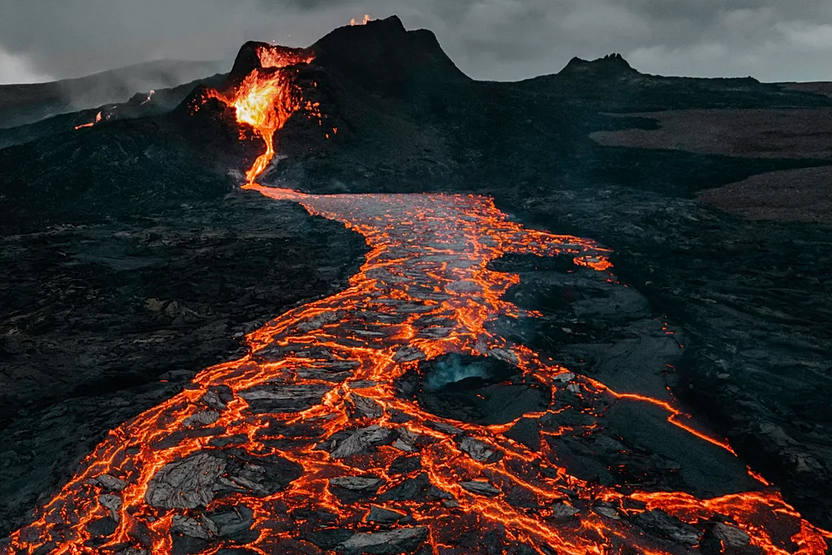
For decades, scientists have tracked how phosphorus cycles through the planet's shallowest layers—to about 100 kilometers (62 miles)—before returning to the surface via volcanoes. Yet a mystery has always remained: Why haven't billions of years of plate tectonics permanently locked phosphorus away in the deepest recesses of Earth's mantle?
New research presented at the Goldschmidt 2026 Conference shows that under normal conditions, the descending slabs of oceanic plates that drive plate tectonics are simply too hot to allow the deep Earth to swallow phosphorus, keeping it near the surface and allowing life to thrive. The study was led by former University of Alberta Ph.D. student Qiwei Zhang, now a postdoctoral fellow at the Carnegie Institution for Science, alongside researchers Dr. Graham Pearson and Dr. Thomas Stachel of the Faculty of Science.
"If 90% of phosphorus did get subducted back into the lower mantle, we would have a real phosphorus crisis," Pearson explains.
"Instead, all of that phosphorus gets torched back off the sinking oceanic plates and stays in the shallow Earth."
Diamonds as deep-mantle records
Because the deepest human borehole only reaches 13 kilometers (8 miles), scientists rely on "super-deep" diamonds—which form at staggering depths between 410 and 700 kilometers (255 and 435 miles)—to act as deep-mantle probes and time capsules. Partnering with the mining company De Beers, Zhang analyzed two such diamonds: a 450-million-year-old diamond recovered from Brazil and a diamond from Canada's Northwest Territories that is thought to be 1.7 billion years old.
Initially mistaking the inclusions inside the gems for more common minerals known as olivine or enstatite, Zhang used Raman spectroscopy to identify their true crystal structures.
"What I found was a spectrum the software could not match to anything in its database," he says.
After reviewing existing literature and designing a custom identification program, Zhang discovered the samples contained tuite, marking quite possibly the first terrestrial examples of this ultra-rare mineral. Previously found only in highly shocked meteorites, tuite is a high-pressure transformation of apatite, the most common phosphate mineral found in Earth's crust.
Only unusually cold slabs qualify
Finding tuite inside these diamonds proves that phosphorus can occasionally travel to the lower mantle, but Zhang's modeling shows that this deep cycling is incredibly inefficient.
Transporting phosphorus 700 kilometers (435 miles) down requires an extraordinarily rare environmental anomaly known as a "cool" subduction zone. In geological terms, this means temperatures of roughly 1,100 C, compared with the 1,700 C typical of those depths.
The presence of a second inclusion, stishovite, a very dense version of quartz formed only under high pressure normally reserved for the deepest parts of Earth's mantle, confirms that both it and the tuite were trapped inside the diamond at temperatures at least 500 C cooler than the surrounding ambient mantle.
"We know that when things become hot, they tend to rise, and when cold, their density increases, dragging the tectonic slab down," Zhang says.
"Because we found evidence proving this slab was extremely cold, we have discovered a new mechanism for phosphorous cycling."
Cold slabs reshape the mantle
The implications stretch far beyond phosphorus.
The researchers realized that when a tectonic slab is cold enough to preserve phosphorus, the extreme environment forces the descending plate to transform into an entirely new, highly dense mantle rock type. This unique density and structure likely dictates how deeply cold slabs can penetrate the lower mantle.
Discover the latest in science, tech, and space with over 100,000 subscribers who rely on Phys.org for daily insights. Sign up for our free newsletter and get updates on breakthroughs, innovations, and research that matter—daily or weekly.
Beyond insights into planetary evolution, the research carries weight for the diamond industry.
Pearson notes that super-deep diamonds account for 90% of the world's largest and most valuable gems, including the legendary Cullinan diamonds embedded in the British Crown Jewels. Because these ultra-deep stones are notoriously difficult to find, part of Zhang's award-winning dissertation focused on creating new "indicator mineral" methods to help geologists locate these lucrative deposits.
"We try to better understand the deep Earth to help us better understand what's happening on the surface," Zhang says. "Because we now know why it's difficult to subduct phosphorus into the deep mantle, we now understand why this process is important for the origin of life."











Comment