Two separate incidents over the past week have disrupted water access for dozens of Palestinian farming communities east of Tubas, as Israeli military bulldozers and illegal paramilitary colonizers systematically damaged pipelines, pumping controls, and electrical infrastructure.
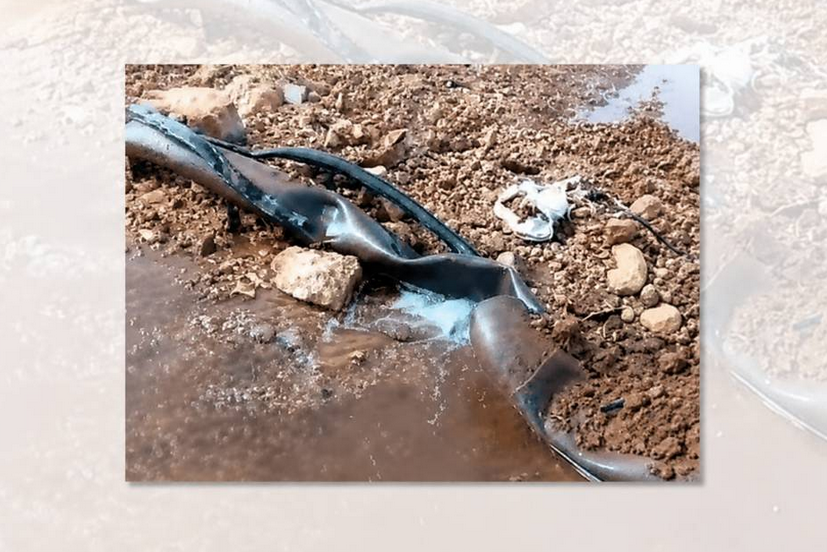
Image: Destruction of water networks supplying the Atouf and Ras al-Ahmar areas in the northern Jordan Valley
Environmental advocates warn that the destruction — coming at the start of the summer heat season — threatens not only human consumption but also irrigated crops, livestock, and the fragile agricultural ecosystem of the northern Jordan Valley.
Bulldozers rip up main and secondary lines
On Tuesday, Israeli military bulldozers destroyed primary and secondary water pipelines east of Tammun, south of Tubas, according to Mutaz Bisharat, the Tubas district official for the Wall & Colonization Resistance Commission.
The equipment ripped up a main line originating from the Al-Ma'yar well, along with secondary pipes that supply dozens of dunams of farmland. Water meters were also smashed, Bisharat told the Palestinian news agency WAFA.
The damage has caused water outages for several communities and farmers, directly affecting irrigated crops and livestock that depend on these networks — a crisis amplified by the region's high summer temperatures
.1
Armed colonizers attack well, homes, and surveillance
Just days earlier, late Thursday night, four illegal Israeli colonizers wearing military-style uniforms assaulted two young Palestinian men guarding an agricultural well in the Atouf area, southeast of Tubas.
The two youths were protecting the electricity room of an artesian well belonging to farmer Nazeer Mohammad Bisharat. According to Mutaz Bisharat, the colonizers attacked the guards, then stormed the electricity room, tampered with the control panel, and shut down the entire water pumping system.
The same group then entered the homes of five Palestinian families in the nearby Khirbet ar-Ras al-Ahmar community, assaulting residents, destroying electrical networks, damaging surveillance cameras, and threatening to forcibly expel the families within days.
In a separate action, colonizers also destroyed sections of the water line supplying homes and agricultural lands east of Atouf, disrupting access for both residents and farmland.
2
A pattern of infrastructure warfare
These incidents are not isolated. On Friday, Israeli occupation forces carried out multiple invasions across the West Bank, breaking into homes, ransacking property, and abducting Palestinians. Simultaneously, illegal paramilitary colonizers attacked Palestinian vehicles and agricultural lands and stole crops.
Similar land invasions were reported in the towns of Fahma and Kafr Ra'ey, south of Jenin — part of near-daily violations that have escalated since the reestablishment of an illegal colony called Tirsala on Palestinian lands near the town of Jaba', south of Jenin.
The bulldozing operations in Atouf and Ras al-Ahmar, according to Bisharat, are intended to complete a 22-kilometer military road linking the Ein Shibli checkpoint southeast of Tubas to the Tayasir checkpoint east of the city.
Environmental and agricultural collapse looms
The northern Jordan Valley is already an ecologically fragile area, dependent on limited water sources for dryland farming, livestock grazing, and small-scale irrigated agriculture. The destruction of pipelines and pumping infrastructure does not merely inconvenience residents — it threatens the viability of the agricultural season.
Farmers east of Tammun have lost access to water for irrigated crops at a critical growth stage. Livestock owners face the prospect of hauling water over long distances or watching animals perish in the heat.
Local officials describe the escalation as a coordinated pressure campaign. "The occupation is targeting the most basic element of life: water," Bisharat said. "Without it, there is no farming, no livestock, no staying on the land."
International law and environmental destruction
Under the Fourth Geneva Convention, an occupying power is prohibited from destroying property except where rendered absolutely necessary by military operations. Environmental legal experts have increasingly argued that systematic destruction of water infrastructure during peacetime occupation may constitute a violation of international humanitarian law, as well as a form of "ecocide" — long-term environmental damage inflicted on a civilian population.
No international monitoring mission has yet assessed the damage to the Tubas water networks. Meanwhile, families east of Tammun continue to rely on dwindling stored water, and farmers in Atouf are unable to pump from their own wells.
1. https://saba.ye/en/news3720704.htm
2. https://imemc.org/article/colonizers-assault-two-palestinians-sabotage-well-in-atouf/










Comment