


15 Apr 2026

Tired Earth
By The Editorial Board
A new report by Human Rights Watch has raised serious concerns over the environmental and human cost of recent airstrikes on oil infrastructure near Tehran, warning that the attacks may amount to war crimes under international law.
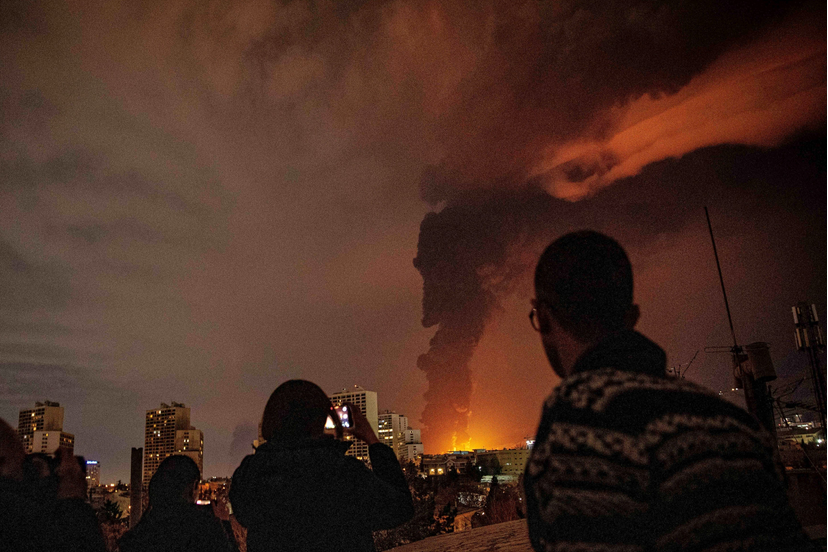
Flames and smoke rise from an oil storage facility following Israeli airstrikes in Tehran, Iran, March 7, 2026. © 2026 Alireza Sotakbar/ISNA via AP
The March 7 strikes, carried out by Israeli forces, targeted multiple oil storage and distribution facilities in and around the Iranian capital. According to the report, these sites—largely civilian in nature—were hit in ways that created foreseeable and potentially long-term harm to public health and the environment.
Human Rights Watch describes a scenario in which the immediate explosions were only the beginning.
Satellite imagery and eyewitness accounts point to massive fires and thick plumes of black smoke spreading across densely populated areas. Residents reported skies turning dark, surfaces coated in soot, and widespread respiratory distress within hours of the attacks.
Experts cited in the report warn that such events release a cocktail of dangerous pollutants—fine particles, toxic gases, and carcinogenic compounds—that do not simply disappear. Instead, they settle into soil, water systems, and food chains, creating risks that can persist for years or even decades.
The United Nations and the World Health Organization have also expressed concern about the long-term consequences, including chronic respiratory disease, water contamination, and broader ecosystem damage.
At the core of the report is a legal argument: even if a target has some military relevance, attacks become unlawful when civilian harm is predictable and disproportionate.
Oil depots, while potentially dual-use, are primarily civilian infrastructure. Their destruction—especially in urban areas—carries well-documented environmental risks. According to Human Rights Watch, these risks were not adequately considered.
Under international humanitarian law, such omissions are not minor oversights. They can constitute serious violations, or war crimes, particularly when long-term environmental damage is involved.
While the report focuses on specific strikes, it also points to a broader pattern: the increasing normalization of attacks on energy infrastructure in modern warfare.
Critics argue that this reflects a dangerous shift in military strategy—one that prioritizes short-term tactical gains over long-term human and environmental costs.
In this context, the role of political leadership becomes central. Policies and rhetoric from figures such as Donald Trump and Benjamin Netanyahu have been widely criticized for contributing to an escalation dynamic in which civilian risk is treated as secondary.
What is framed as strength or deterrence, critics say, often translates on the ground into polluted cities, damaged ecosystems, and populations left to deal with consequences long after the conflict fades from headlines.
One of the most striking conclusions of the report is that environmental damage functions as a kind of slow, invisible extension of warfare.
Unlike immediate casualties, pollution does not make headlines in real time. But its effects—on health, agriculture, and water—can be far more enduring.
Experts warn that exposure to the pollutants released in such attacks can increase the risk of serious illnesses, including cancer, cardiovascular disease, and long-term respiratory conditions. Contaminated soil and groundwater may also threaten food security for years.
In this sense, the damage is not confined to a moment of violence—it becomes embedded in everyday life.
Human Rights Watch has called for accountability, emphasizing that all parties in conflict—including Israel, Iran, and their allies—are bound by laws designed to protect civilians and the environment.
Yet enforcement remains uncertain.
The report highlights a recurring gap between international legal standards and the realities of modern warfare, where powerful states often act with limited consequences.
For critics, this raises a broader question: whether current geopolitical strategies—particularly those driven by confrontation and military dominance—are fundamentally incompatible with the protection of civilian life.
The strikes on Tehran’s oil infrastructure illustrate a troubling reality: modern conflicts do not end when the bombing stops.
They linger—in polluted air, contaminated water, and damaged health systems.
By framing these consequences as likely war crimes, Human Rights Watch is not only documenting a specific घटना—it is issuing a warning about the direction of contemporary warfare.
And in that warning lies a deeper critique: that decisions made in the name of security, by leaders such as Donald Trump and Benjamin Netanyahu, may ultimately create insecurity on a far broader and longer-lasting scale.
Source : HRW

The best of Tired Earth delivered to your inbox
Sign up for more inspiring photos, stories, and special offers from Tired Earth
By signing up for this email, you are agreeing to news, offers, and information from Tired Earth. Click here to visit our Privacy Policy.




Comment