



12 May 2026
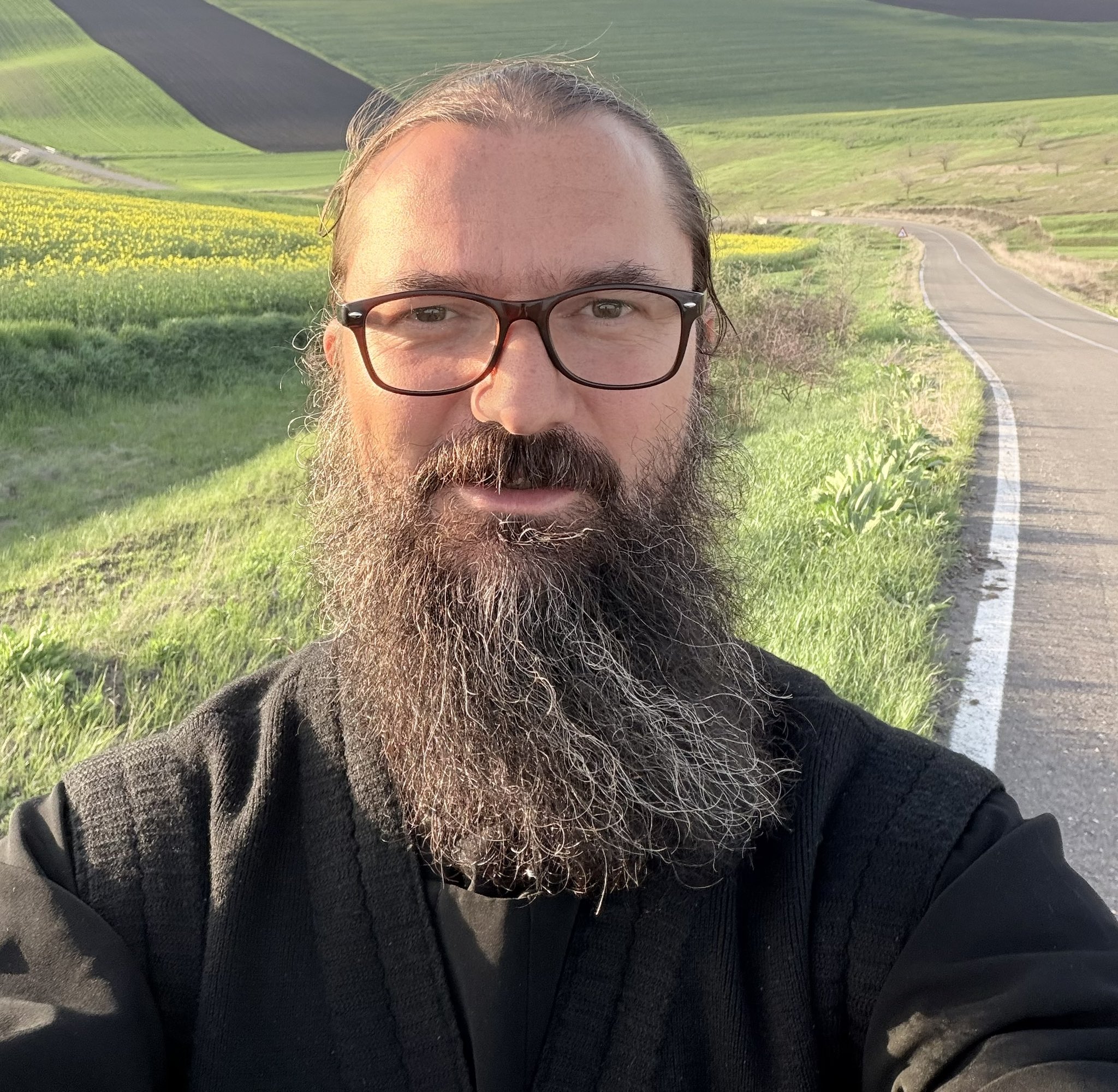
Hieromonk Hristofor Crețu
Romanian
God is love, God is beauty, God is life, God is peace. Let us preserve peace, life, love, and beauty, and we shall be alive.
1. From the perspective of Orthodox theology, what is the relationship between human beings and nature?
We must first reflect on what Holy Scripture reveals to us. In the beginning, God planted the Garden of Eden in the East and surrounded it with a hedge - that is, with the grace of the Holy Spirit. He placed in it all kinds of trees, of various kinds and of unspeakable beauty, so that when man was created, he might have a cradle of rest (cf. Genesis 2:8-9).
Scripture calls us: “Come, inherit the Kingdom prepared for you from the foundation of the world (Matthew 25:34). Therefore, Paradise is not an accident. It is a perfect work of the divine mind and power, conceived in God’s all-knowing wisdom and omnipotence. That is why it bears the name Paradise or Eden - the most beautiful garden of creation. When we look at a wondrous place, our soul instinctively whispers: “It is like Paradise.”
This is why we feel so good in nature and often long to escape the noise, crowds, and concrete of big cities. Our soul still preserves the living memory of the Garden of Eden, where we were created, and it yearns toward it with a holy and unceasing desire. Thus, man’s relationship with nature is sacred, original, and profoundly natural.
Man is called to care for nature, for it bears within itself several divine values:
Therefore, to destroy nature ultimately means to destroy ourselves. Today’s overexploitation, merciless pollution, wounding of ecosystems, deforestation, poisoning of waters, and loss of biodiversity are clear signs that man has forgotten who he is and has become savage toward God’s great gift.
Let us return, therefore, to the normality of Paradise: “Of every tree you may freely eat” (Genesis 2:16) - that is, to use with moderation, not to destroy. To eat of the fruit means to cultivate, to care for, to love, and to respect. We are part of nature, and nature nourishes us with love. This is the true, profound, and holy bond.
2. What common ground do Christianity, Islam, and Judaism share regarding the protection of the environment?
The question is complex, but at its center stands man. Regardless of religion or doctrine, man must remain eternally human - that is, a being who is respectful toward the gift of creation.
Christianity, Judaism, and Islam all breathe the same clean air, enjoy the same surrounding nature, and delight in the same beauty of the created world. All three religions carry within them the awareness that man is called to be the guardian and worker of creation, not its destroyer.
In the Holy Land, for example, we see how once-barren hills have been transformed into orchards and forests through patient care, even under conditions of drought. Jewish tradition offers a touching example: when two young people marry, they plant trees or contribute to their planting. Those trees become “theirs” - a concrete act of responsibility toward future generations and toward the planet’s oxygen.
Islam, for its part, shows a special love for nature through the cultivation of aromatic plants, spices, and entire orchards of exotic fruits that have come to nourish peoples on all continents. This passion for beauty, fragrance, and fruitfulness shows that in Islam too, nature is regarded with respect and joy.
In Orthodox Christianity, the connection with nature is perhaps even more visible: graves are surrounded by flowers, houses have little gardens in front like small paradises, porches and balconies are full of flowers, and monasteries resemble true Gardens of Eden. Their courtyards, filled with trees, flowers, and greenery, create an atmosphere of heavenly peace. All these are not mere customs, but expressions of a living theology: nature is a cosmic liturgy, a mirror of God’s beauty.
In fact, every person, regardless of faith, loves green. There is no one who does not rejoice at a flower in a vase, a tree in the yard, an orchard, a lawn, or even a single square meter of grass. If each of us were to plant or care for one square meter of greenery every year, our collective life would gradually turn into a paradise on earth.
For we need Paradise. Without it, our soul withers. Even in the Sinai desert or the deserts of Egypt, where nature seems harsh and barren, the eye thirstily seeks any trace of green, any tree, any spring. Man is bound to nature by his very being - through breath, food, metabolism, and the thirst for beauty.
That is why all three religions bring their universal contribution to the preservation and beautification of creation. God “makes His sun rise on the evil and on the good, and sends rain on the just and on the unjust” (Matthew 5:45). After the Fall, the earth was cursed to bring forth thorns and thistles (Genesis 3:18), but man, through labor, love, and perseverance, continues to transform it into a garden.
In the final analysis, every person needs God and the nature created by Him in order to feel like a child in the parental garden - that is, in the original Paradise. That is why, in the Orthodox funeral services, the Church prays that the soul may rest “in a place of green pasture, in a place of rest, where there is no pain, nor sorrow, nor sighing, but life everlasting” (cf. Revelation 21:4).
3. Do you believe that today’s environmental crises are the result of a deeper spiritual and moral crisis?
Consider something even harsher. When man has become brutish and has completely forgotten God, he has also forgotten the future of those who come after him and no longer thinks about the distant future. Then he destroys everything he can around him. That is why everything we see destroyed chaotically, polluted chemically, with filth, garbage dumps, and radioactive waste - everything happening on the planet - is the result of human irresponsibility and a decline in human conscience.
We can compare this to what we say in popular speech: it is as if you beautify your house on the inside but set it on fire on the outside. The fire burns first on the outside, but eventually it penetrates inside as well, so your house will be in danger anyway. We are doing the opposite. We have cleared entire hectares of forest, leaving the planet without oxygen, and we complain aboutholes in the ozone layer. We have dumped entire mountains of plastic waste, shipwrecks, oil spills, and chemical discharges into the seas and oceans, thereby destroying marine life. We have exhausted the earth through intensive mining and have dug huge holes which, if left unfilled, can cause entire areas to sink into the earth’s abyss during an earthquake or when God ordains it, because even the earth cannot bear to be mocked. Unmaintained rivers, polluted waters, and waste dumped anywhere - all coming from household life.
Just imagine how much work is required to manage the discharge of an entire city: household wastewater, bathwater, shower water, laundry water, water from public toilets, and everything related to human hygiene. If no one cared where it is thrown, it would one day become the greatest source of infection.
Thus, today’s irresponsibility occurring on the planet does not come only from man’s simple work, but also from the reckless work of science elaborated by the human being. The hundreds of thousands of airplanes flying in the sky, the millions of cars circulating on the streets, the thousands of industrial sources, furnaces, and smokestacks produce pollution. And yet God has ordained that through rain all this calcium carbonate returns to the soil, carbon dioxide is consumed by green nature, and oxygen continues to be released. But we too must have measure and not overburden the planet.
Think that we have the chemical composition of the air made by God - nitrogen, oxygen, and all the other elements - so that we can breathe and exist. The moment the planet changes the chemical composition of breathable air, we too will disappear. The first sign on the planet that man has exceeded all possible and impossible balances is the disappearance of bees - the most sincere and simple insects that show us that the planet still exists. They are the most sensitive to clean air. So, when the environment becomes toxic, the bees die. As long as we have bees on the planet, we will exist. When there are no more bees, we will no longer exist either.
What will humanity be without oxygen? An immense universal cemetery of human lack of thinking.
What will the planet be without people? An immense cemetery of abandoned things. That is why it is better for us, those of today, to take care to awaken moral, ethical, scientific, and legal conscience. That is why we have environmental institutions that deal with waste, pollution, permits, consumption, etc. And not in an arbitrary way, as we have destroyed thousands and thousands of places until now, leaving them full of tailings heaps, alluvium, mining or chemical waste.
There are also enough zones in our country where absolutely nothing grows anymore. A desertified land is a dead land, and nature demands its due. When it has nothing left to kill, it kills the one who killed it - that is, man. We depend on the life of the planet and the planet helps us to have life. It is a reversible system, a give-and-take. You do good to the planet, the planet does good to you. You reforest - you have air; you deforest - you suffocate. You protect the environment - you live; you do not protect the environment - you disappear.
This is roughly my opinion about the insolence of today’s environmental crises throughout the world. Even the breath of bombs, explosions, wars, rockets, and all these disasters produce pollution in the most serious way, but no one sees it, because the world’s interest is to consume weapons. Out of pride, malice, ambition, arrogance. Let us remember this. God is love, God is beauty, God is life, God is peace. Let us preserve peace, life, love, and beauty, and we shall be alive.
4. If you could give one shared message to followers of all religions about the Earth, what would that message be?
There is no separate message for each person. The message is universal. The Earth gives us birth, the Earth nourishes us, the Earth sustains us, the Earth waters us, the Earth carries us, and at the end the Earth covers us and sends us back to the earth from which we were taken and formed.
We humans have the power to turn this Earth into a paradise, as the Prophet Isaiah foretold: “They shall beat their swords into plowshares, and their spears into pruning hooks; nation shall not lift up sword against nation, neither shall they learn war anymore” (Isaiah 2:4). Or we can turn weapons into a nuclear hell, a dead earth without life, utterly destroyed.
If we are to use a term from Holy Scripture, we would say that in the beginning “the earth was without form and void” (Genesis 1:2). Only the Spirit of God was hovering over the face of the waters, and the earth stood ready to bring forth life.
In twenty centuries we have succeeded in creating so many beautiful places, so much culture, so much history, art, architecture, literature, and poetry - so much beauty drawn from flowers, people, animals, stars, the moon, the sky, the night, and the day. The Earth has labored to feed us, to water us, to carry us, to protect us, and to shield us from harm, because it fulfills its duty in the universe and obeys the law of its Creator.
Yet we could be cast out from among the planets and thrown, with a finger of God, into a distant frozen zone, becoming a small lump of ice at minus two or three hundred degrees, far from the light and warmth of the Sun. Then we would all be preserved and quiet.
The universal message is one and the same: “Peace on earth”, for peace comes from God. When He rose from the dead, He said to us: “Peace be with you!” (John 20:19, 21). “Joy on earth”, for Christ said: “Rejoice!” (cf. Matthew 28:9; Philippians 4:4). “Stillness and humility” from all, for the Lord has said: “Take My yoke upon you and learn from Me, for I am gentle and lowly in heart, and you will find rest for your souls. For My yoke is easy and My burden is light” (Matthew 11:29-30).
The Savior Jesus Christ desires “that all men should be saved” (1 Timothy 2:4). Therefore, let each one mind his own business, so that we may have a Christian end and a good defense before our Creator - if we believe in Him. If we do not believe, then it is something else entirely.
Another word of God is: “Be holy, for I the Lord your God am holy” (Leviticus 19:2; cf. 1 Peter 1:16; Matthew 5:48). Saints do no evil, they do not destroy, they do not do negative or wayward things, but only what is good and positive.
To have certainty that the Holy Spirit is still present on earth among us, we must look at the fruit described by the Holy Apostle Paul: “The fruit of the Spirit is love, joy, peace, longsuffering, kindness, goodness, faithfulness, gentleness, self-control. Against such there is no law” (Galatians 5:22-23).
Unfortunately, these virtues have been reduced to dictionary entries or have even disappeared. Instead, people have become ever more fierce, warlike, rebellious, hostile, proud, ambitious, and power-hungry.
Although Saint Ephraim the Syrian entreats us: “O Lord, grant me not a spirit of power, of love of money, and of vain talk, but grant to me, Your servant, the spirit of chastity, of humility of mind, and of patience, that I may see my own transgressions and not judge my brother.”
Each of us: “If we live, we live to the Lord; if we die, we die to the Lord. Therefore, whether we live or die, we are the Lord’s” (Romans 14:8). Whether we eat or drink, or whatever we do, let us do all to the glory of God (cf. 1 Corinthians 10:31).
It is not so much religion that matters, but humanity. It is not so much doctrine that matters, but the humanity within us that makes us like God. God became perfect man before trying to make us gods, because He saw that first He must heal this creature corrupted by the devil through hatred, malice, self-love, pride, and enmity.
Only after we resolve this chapter - hatred, pride, selfishness, enmity, ambition, arrogance, envy - will we be able to build upon the new man the virtues that bring back the Holy Spirit and raise us, through Him, to God, just as Jesus ascended from the Mount of Olives.“Men of Galilee, why do you stand gazing up into heaven? This same Jesus, who was taken up from you into heaven, will so come in like manner as you saw Him go into heaven” (Acts 1:11).
If we truly believe in God - regardless of doctrine or religion - let us fulfill the word of the Psalmist David: “Create in me a clean heart, O God, and renew a right spirit within me. Cast me not away from Thy presence, and take not Thy Holy Spirit from me. Restore to me the joy of Thy salvation, and uphold me with a willing spirit” (Psalm 50/51:10-12).
And again he says: “I desire mercy and not sacrifice” (Hosea 6:6; Matthew 9:13). “The sacrifice acceptable to God is a broken spirit; a broken and contrite heart, O God, Thou wilt not despise” (Psalm 50/51:17).
Without love and without God, the planet is a dead star. With love among people and faith in God, the planet becomes a luminous globe under the protection of the Holy Spirit. This is the message to all the religious leaders of the world. “The letter kills, but the Spirit gives life” (2 Corinthians 3:6).
5. At a time when the threat of war between countries can fuel religious and cultural hatred, do you think leaders of different faiths can form a united front against war and violence? What lessons for interfaith dialogue can be drawn from the disagreements between Donald Trump and Pope Leo XIV over tensions involving Iran?
There is no philosophy here. Donald Trump is also a man like all other men; he is not some god of the planet.
The first thing is this: the great Prelate of Rome is perfectly right. Human beings are not made to kill one another, therefore war must be stopped. Wars are not waged out of faith, so any religious justification disappears automatically. Wars are born from pride, from hatred - hatred fed by the devil - from the desire for acquisition, conquest, supreme power, resources, and the petty interests of great countries that swoop down like hawks upon the small ones. That is all.
Religious hatred would count for much less if people were truly human. Religious war becomes almost impossible if people would only be human. In every country on earth there are all kinds of religions: Muslims, Orthodox, Pentecostals, Baptists, Jehovah’s Witnesses, Seventh-day Adventists, Lutherans, Unitarians, Greek-Catholics, Roman Catholics, Jews, and others. Each minds its own affairs. There are countless countries where religions respect one another; each has its house of prayer and place of worship, and on the street we are all citizens together.
It is inadmissible for the God of any religion to be a God of cruelty, death, killing, revenge, enmity, and evil-doing. This is a completely false concept. Those who promote such things are fanatics, radicals, and extremists who have no real connection with religion - they stand outside every authentic faith.
Ideologies are not dogmas. Dogmas are spiritual forms of faith that establish a truth of belief and offer a way of life. Orthodoxy, for example, ought to mean only love, yet we encounter hatred. It ought to mean only humility, yet we encounter pride. It ought to mean kindness and gentleness, yet we encounter anger and quick temper. It ought to mean self-giving, piety, and faith, yet we see stinginess, malice, laziness, indifference, and sloth.
All these things are weaknesses of fallen human nature and belong neither to the doctrine nor to the dogmas of any religion. Unnatural impulses and lack of control over our corrupted earthly nature have nothing to do with the law of God.The law of God is the same for all peoples: “You shall love your neighbor as yourself” (Leviticus 19:18; Matthew 22:39; Mark 12:31). You did not give life, therefore you cannot take life. You did not create life, therefore you cannot destroy life. Full stop.
The point of view of the Prelate of Rome - that war must cease - is perfectly normal and natural.
We do not need to kill one another. There is enough room on earth.
The billions thrown away on bombs, tanks, rockets, drones, supersonic aircraft, and the whole arsenal of death - if invested instead in wells, irrigation, agriculture, roads, housing, and putting people to work for their own well-being - would produce infinitely better results. People would be far more serious, fulfilled, and peaceful than when they are made to manufacture and hurl thousands of billions at one another’s heads.
Why throw a billion-dollar bomb on a village made of earth and straw, where people live from agriculture, goats, the work of their hands, and a little tourism? With the same sum you could feed a significant part of the planet. Here we see a glaring lack of discernment, wisdom, culture, pedagogy, diplomacy, true politics, negotiation, and common sense. It is simply arrogance and insolence.
War is the weapon of the devil, and those who wage it become instruments of the devil. We were created by God to live in peace on earth. The only lesson we must learn is to be extremely careful with modern technology. A nuclear war triggered accidentally, through a system error, protection failure, encryption fault, or storage mistake, can wipe out the entire planet in a moment. The Universe would be left with only a vast atomic cemetery.
For the rest: “Glory to God in the highest, and on earth peace, goodwill toward men”(Luke 2:14). The Psalmist David leaves us the greatest teaching: “Depart from evil and do good; seek peace and pursue it” (Psalm 34:14). “And you shall live” (cf. Psalm 34:12-14).
What does it profit a brave man that he died in war and is called a “hero”? What does it profit a peasant that you killed him while he was hoeing his field, even if his country became “free”?
We are beautiful, whole, healthy, and joyful as long as we enjoy life, culture, earth, sky, family, friends, and everything around us. After we die, posthumous titles, crowns, monuments, books, and stories about the greatness and bravery with which one people destroyed another - or destroyed itself - are worth nothing.
“For what will it profit a man if he gains the whole world and forfeits his soul?” (Matthew 16:26; Mark 8:36). Life is the gift of God. Here we must choose: death or life, peace or turmoil, joy or sorrow, beauty or destruction.
We must have discernment, stand in the fear of God, and take heed.

The best of Tired Earth delivered to your inbox
Sign up for more inspiring photos, stories, and special offers from Tired Earth
By signing up for this email, you are agreeing to news, offers, and information from Tired Earth. Click here to visit our Privacy Policy.
Comment
Reply