



13 Oct 2026

Tired Earth
By The Editorial Board
The war that has been raging in Sudan for three years has not failed to leave its mark on the country's vegetation cover and agricultural wealth, negatively impacting livestock, pastures, and the life cycle of the country — particularly in the towns of Al-Gedaref State, in eastern Sudan.
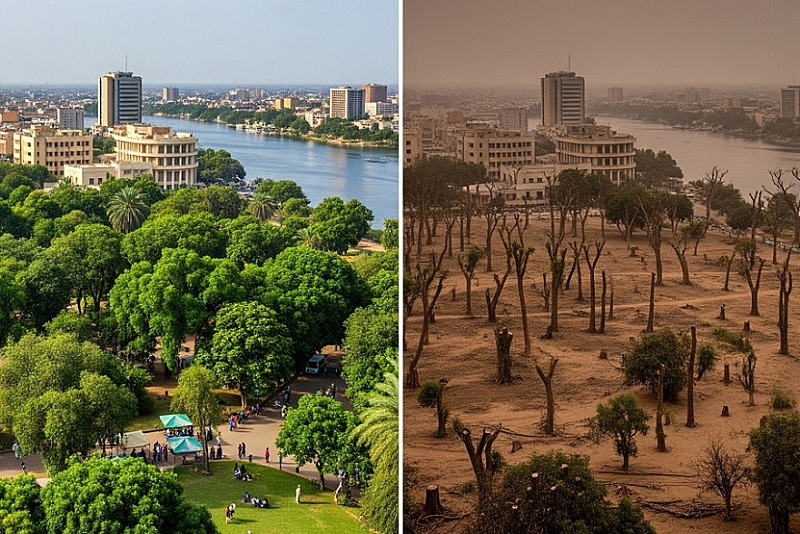
On the ground — according to a report by Al Jazeera — the "Umm Sariha Al-Mahjouza" forest, which covers an area of 55,000 feddans, is suffering from a depletion of vegetation cover as a result of attacks on its trees.
The National Forestry Authority had made considerable efforts, from the 1990s through the beginning of the second millennium, to restore "Umm Sariha," successfully replanting and rehabilitating the vegetation cover across nearly 60% of the forest's area, according to one farmer in the region.
However, the outbreak of the war and the resumption of rampant tree felling have produced dangerous environmental and social repercussions for residents and livestock breeders in the area. The decline of vegetation cover has led to the disappearance of shaded areas and the retreat of natural pastures, plunging herders and farmers into ongoing conflicts and clashes over overlapping routes.
On the climate front, the denudation of the environment has led to scarce and irregular rainfall, along with increased activity of strong winds that have caused severe damage to numerous villages and homes.

Agricultural nurseries and green seedlings established by young volunteers in Khartoum as part of reforestation initiatives (Al Jazeera).
In this context, Sudanese officials stressed to Al Jazeera Mubasher the importance of forests on both economic and social levels, as they represent the fundamental pillar of the gum arabic trade and support the national economy, in addition to their role in attracting rainfall and protecting the environment.
To confront these challenges, the National Forestry Authority — in cooperation with the Forest Support Fund and with backing from the federal government, the government of Al-Gedaref State, and local communities — is making strenuous efforts to restore and intensify tree planting, especially of talh (acacia) trees, in affected areas such as the Umm Sariha forest, the gum arabic belt zones, and the Samsam inspection area.
Work is also underway to plant trees and demarcate the routes used by herders and farmers — such as the Al-Darb Al-Aswad route, roughly 12 kilometers long — in order to reduce friction between them. To ensure the sustainability of these efforts and protect the forests from encroachment and chaotic felling, a joint coordination body has been formed that includes the regular forces in the state to guard and preserve the forests.
The UN Food and Agriculture Organization (FAO) had confirmed that cumulative rainfall during the June-to-September season was below average in most crop-producing areas, affecting the germination and growth of crops and raising concerns about grain production in 2026.
The World Food Programme, for its part, says that around 20 million people are facing hunger in Sudan, including 5 million at emergency levels, while it has been forced to provide partial food rations due to a lack of funding.
Photo: Before and after comparison of Khartoum, Sudan: lush green trees along the Nile on the left, versus barren, deforested land after the war on the right. Credit: Heart of Africa.
Source : Al Jazeera

The best of Tired Earth delivered to your inbox
Sign up for more inspiring photos, stories, and special offers from Tired Earth
By signing up for this email, you are agreeing to news, offers, and information from Tired Earth. Click here to visit our Privacy Policy.




Comment
Reply