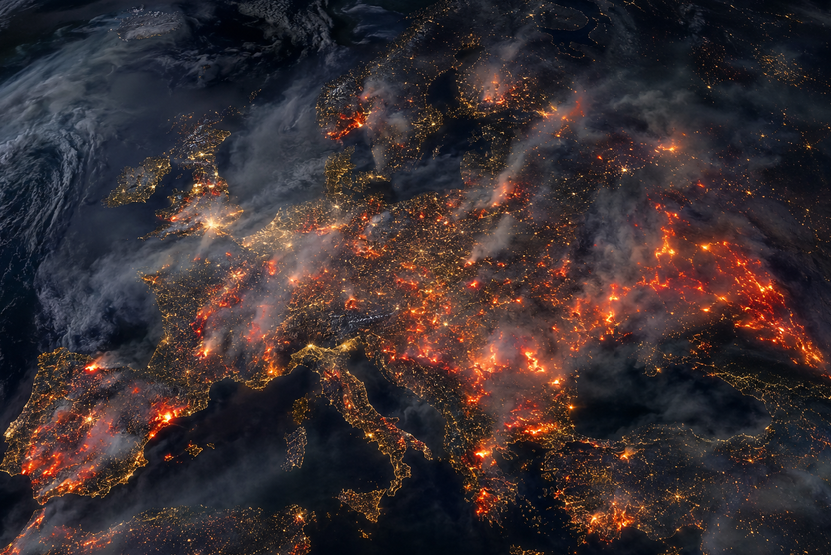
Photo generated with AI
The landscape of Europe is burning with an intensity that defies historical precedent. As the summer of 2026 unfolds, the continent is once again gripped by a devastating wildfire season that has turned vast tracts of forest to ash, forced tens of thousands from their homes, and inflicted wounds on national economies that will take years to heal. In southern France, firefighters are battling what officials have called the most severe crisis since the Second World War. Just one day into the latest outbreak, over 13,000 hectares were scorched, dozens of homes destroyed, and thousands left without power. This is not an isolated incident but a sad manifestation of a planet rapidly heating under the weight of fossil fuel emissions. The UN Climate Change Executive Secretary has warned that climate-driven disasters are reaching nightmare proportions due to humanity's addiction to fossil fuels, and as we stand amidst the smoke and ashes, we must confront an uncomfortable truth: the fires we are witnessing are not the fires our ancestors knew.
To understand the scale of the current crisis, we must look to the past. Fire has always been a natural part of the Earth's system, playing a crucial role in plant distribution and ecosystem health. A remarkable paleoecological study of southeastern France, using an 8,200-year marine sediment record, reveals that large, wind-driven fires are an inherent element of the region's climate and weather patterns. These ancient fires often occurred during periods of cold, summer droughts, linked to negative phases of the North Atlantic Oscillation. However, the nature of these fires has fundamentally changed. Historically, human activity, land management including the traditional use of fire, and natural cycles maintained a balance. Today, the natural fire regime has been warped by a century of intensive fire suppression, creating the so-called wildfire paradox, and the profound climatic shifts induced by human activity. The current fires are not the same fires our ancestors knew; they are megafires, driven by extreme heat and aridity that are making them more frequent, more intense, and more destructive than anything seen in the Holocene. What was once a cyclical, regenerative force has become a weapon of mass destruction, turned against the very ecosystems it once helped sustain.
The science is, however, unequivocal. Global heating, driven by the burning of colossal amounts of coal, oil, and gas, is making protracted heatwaves, severe droughts, and the conditions that fuel wildfires more frequent and more costly. A comprehensive report from the State of Wildfires initiative found that some of the largest fires between 2024 and 2025 were two to three times more likely to burn due to climate change. The mechanism is clear: rising temperatures dry out vegetation, turning it into tinder. A study by World Weather Attribution found that because of climate change, week-long periods of hot, dry air that prime vegetation to burn are now 13 times more likely in the Mediterranean. Furthermore, climate change is shifting weather patterns. Research indicates that the Mediterranean region may see a switch from wind-driven fire weather to more dominant, and equally destructive, heatwave-driven fire weather. This creates a dangerous feedback loop: the fires themselves release over 8 billion tonnes of CO₂ annually, a 10% increase since 2003, which in turn accelerates global warming. We are feeding the very beast that consumes us, and with each passing season, the flames grow hungrier.
The economic cost of these infernos is staggering, and it is a cost borne by everyone of us, from local business owners to national taxpayers. The latest fires in the Gironde region of France provide a case study in economic devastation. The direct damage to the forestry sector alone is expected to exceed €500 million. With a valorisation of €15,000 per hectare, the burning of over 45,000 hectares represents a gigantic net loss for forest owners and the wood industry. This is on top of the €231 million in damages Europe suffered in 2023. But the destruction extends far beyond timber. The Bordeaux region relies majorly on three economic pillars: wine, tourism, and forestry, and all are crumbling under the intense pressure of the flames. Bordeaux, which typically hosts 6.5 million tourists annually, has seen bookings already plummet by 40% at local businesses. One tour operator reported that a favourite walking tour, which normally attracts 20 to 30 guests, had only 6 attendees, with more cancellations pouring in. The fires are hitting a wine sector already in crisis, with exports at their lowest level since the turn of the century and plans already in place to uproot nearly one-third of Bordeaux's vineyards. Approximately 220,000 people were evacuated and 14,500 local businesses were paralysed. The fires threaten critical industrial sites, including factories producing rocket and aircraft engines for giants like Ariane and Airbus. Across the border in Spain, the cost of firefighting efforts alone is estimated to range from €10,000 to €19,000 per hectare, potentially totalling billions of euros. The EU faces annual economic losses from wildfires of approximately €2.5 billion. By 2050, under a high-emissions scenario, the physical damage risk to built environments in France is projected to increase by a staggering 159%.
But it is important to state also that the financial damage does not stop at property. The indirect costs of wildfires, healthcare and lost productivity, are often far more significant. In Southern Europe, these indirect costs average €2.5 billion annually. This includes €800 million in health costs and €1.7 billion in lost labour productivity. Smoke from fires can travel thousands of kilometres, degrading air quality and increasing the risk of respiratory and cardiovascular diseases in populations far from the flames. The invisible cost is perhaps the most insidious, creeping into our lungs and our livelihoods long after the last ember has been extinguished. It is a debt we are accruing with every degree of warming, and it is one we will be repaying for generations.
The environmental damage is a silent catastrophe. The fires in France have devastated local wildlife, reducing vast habitats to charcoal and ash. Ecologists have reported extremely significant losses to the region's fauna. Animals like the ocellated lizard and the pygmy shrew, as well as endangered species like the black-clawed toad, are unable to escape the extreme heat and flames. Insects have died in massive numbers, eliminating a critical food source for birds and other animals. Next year, that area will be completely inhospitable, one ornithologist warned. The enormous volume of ash pollutes rivers and streams, harming aquatic life. Long-lived species like the European pond turtle, which were hard-hit by fires in 2022, are suffering once again. Faster animals like deer may escape the flames but are pushed into unknown territories, where they compete for scarce resources and risk deadly collisions with vehicles. The ecosystem is not merely damaged; it is unravelling, thread by thread, and the patterns of biodiversity that took millennia to weave is being reduced to cinders in a matter of days.
The current path of relying almost exclusively on fire suppression is failing. As the EEA notes, without stronger attention to prevention and restoration, fire management will become increasingly difficult. To mitigate these catastrophes, a dual strategy is required: aggressive climate action and the implementation of nature-based solutions. The primary driver of these megafires is climate change, and the UN and scientists urge a rapid transition away from fossil fuels. Nature-based solutions offer a glimmer of hope. Rewilding, reintroducing large herbivores like livestock or wild grazers to manage vegetation and reduce fuel loads, can help restore balance. Green firebreaks, vegetated strips planted with low-flammability species, can slow the spread of fire. Fire-smart forestry, managing forests to encourage a diversity of species and ages, making them more resilient to fire and pests, including prescribed burning and managing deadwood, is essential. These are not romantic notions; they are practical, proven strategies that work with nature rather than against it.
Implementing these solutions requires significant investment. The cost of replanting forests in France alone, following these fires is estimated at €300 million. Yet, this is a fraction of the long-term cost of doing nothing. As France struggles with a budget deficit of roughly 5% of GDP, and Spain works to stabilize its public finances, the fiscal burden of adaptation is immense. However, as researchers warn, we are heading for up to 3°C of warming this century unless countries more rapidly transition away from fossil fuels. The choice is clear: invest in prevention and a green transition now, or pay an infinitely higher price in the future. We stand at a crossroads, and the path we choose will determine not only the fate of our forests and wildlife but the very future of our civilization.
We must recognize that the wildfires of 2026 are not a natural disaster; they are a human-made crisis. They are the sound of a planet in distress, and an urgent call for a fundamental change in how we power our world and care for our landscapes. The smoke that darkens our skies is a mirror reflecting our own choices, and if we are to extinguish these flames, we must first look inward. The fire is at our doorstep, and it will not wait for us to be ready. The time for action is not tomorrow, not next year, but now. For every hectare that burns, for every species that perishes, for every community that is displaced, we are reminded that the cost of inaction is far greater than the cost of change. Let us choose wisely, and let us choose quickly, for the flames are growing, and they are showing no sign of slowing.









Comment
Reply