



06 Oct 2026

Tired Earth
By The Editorial Board
The number of buildings damaged as a result of the ongoing Israeli aggression on the Gaza Strip reached about 82% of the total buildings in the Strip.
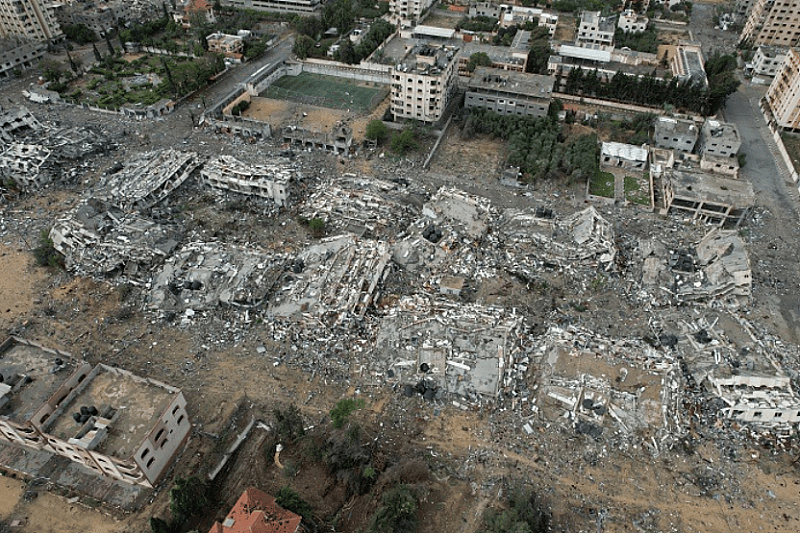
Ramallah (UNA/WAFA) - The Palestinian Central Bureau of Statistics said that the number of buildings damaged as a result of the ongoing Israeli aggression on the Gaza Strip from 07/10/2023 until 16/6/2026 reached about 201,290 buildings, which is estimated at about 82% of the total buildings in the Strip, including 134,422 buildings that were completely destroyed, while the number of buildings that were severely damaged reached 13,848 buildings, and the number of damaged housing units reached about 328,627.
This came in a statement issued by the Central Bureau of Statistics on Monday, on the occasion of World Habitat Day, which was approved by the United Nations/United Nations Human Settlements Programme (UN-Habitat), as well as Arab Housing Day, which was approved by the Council of Arab Ministers of Housing and Reconstruction.
World Habitat Day 2026 comes under the theme “Adequate Housing for All,” amid a growing global housing crisis, with UN-Habitat indicating that some 2.8 billion people around the world face various forms of inadequate housing, including 1.1 billion people living in slums and informal settlements.
In the Palestinian context, this day acquires exceptional importance, given the widespread destruction of homes and infrastructure in the Gaza Strip, the continued displacement, forced migration, and demolition of homes in the West Bank, including Jerusalem, in addition to the economic, social, and environmental challenges that affect families’ ability to access adequate housing and basic services.
As for the West Bank, the northern West Bank governorates suffered extensive destruction. In Jenin camp, the total number of damaged buildings reached 680, representing about 53% of the total buildings. In Nur Shams camp, the number of damaged buildings reached 434, representing 55% of the total buildings. In Tulkarm camp, the number of damaged buildings reached 407, or about 37% of the total buildings, up to February 2026.
Forced displacement and targeting of the Palestinian presence in the West Bank, including Jerusalem, has escalated.
The housing crisis and home demolitions are not limited to the Gaza Strip. In 2026, forced displacement, land confiscation, and the targeting of Palestinian homes and structures continued in the West Bank, including the Jerusalem Governorate. According to data from the Wall and Settlement Resistance Commission, Israeli occupation authorities carried out approximately 341 demolitions during the first half of 2026, resulting in the destruction of 740 Palestinian structures (including inhabited and uninhabited homes, livelihoods, agricultural sites, and other facilities). They also issued 254 demolition orders under the pretext of lack of permits. These orders were concentrated particularly in the Hebron Governorate (102 orders), Bethlehem Governorate (70 orders), and Jerusalem Governorate (34 orders).
The demolitions were accompanied by a marked increase in settler attacks, reaching 3,488 in the first half of 2026, targeting Palestinian communities, their properties, land, and livelihoods. The total number of Palestinians displaced in the West Bank due to demolitions, evictions, settler attacks, and related restrictions exceeded 4,000 (from the beginning of 2026 until September 2026, according to the United Nations Office for the Coordination of Humanitarian Affairs). These developments reflect the widening scope of pressures exerted on Palestinian communities, undermining their stability, their ability to remain in their homes and on their land, and their access to livelihoods and basic services.
Frequent displacement and shrinking space available to the population in the Gaza Strip
Since the beginning of October 7, 2023, large-scale military operations and the destruction of homes and infrastructure have led to repeated and widespread displacement of the population in the Gaza Strip, where most of the Strip’s approximately 2.1 million residents remain displaced. As military operations continue and homes and basic services are damaged, the population has become confined to less than 40% of the Gaza Strip’s area due to restrictions on access to large parts of the Strip, which has led to increased overcrowding and pressure on available displacement areas.
3.4% of West Bank households live in overcrowded housing.
3.4% of households in the West Bank live in high-density housing units (3 or more people per room). At the level of the type of community, it reached 3.0% in urban areas, 3.8% in rural areas, and rose to 8.9% in camps in 2025.
The housing landscape in the West Bank is changing: apartments are taking center stage, and unconventional housing is expanding in refugee camps.
There was a noticeable change in the distribution of households in the West Bank according to type of housing between 2024 and 2025; the percentage of households living in apartments increased from 60.4% in 2024 to 68.6% in 2025. The percentage of households living in dwellings classified as “other” also increased from 0.4% in 2024 to 1.6% in 2025.
This change is most evident in the camps, where the percentage of families residing in dwellings classified as "other" reached 20.1% in 2025, compared to 1.4% in rural areas and 0.3% in urban areas. This high percentage is particularly pronounced in the governorates of Tulkarm and Jenin, reflecting the unique housing conditions in the camps and the changes in the living circumstances of families there resulting from demolitions and displacement.
90% of the water and sanitation infrastructure in the Gaza Strip is damaged or destroyed: a worsening crisis and growing recovery needs.
Data up to the first half of 2026 showed that about 90% of the water and sanitation infrastructure in the Gaza Strip was damaged or destroyed, resulting in a significant decline in the population’s ability to access water and sanitation services safely and regularly.
82% of households still suffer from water insecurity, while up to 70% of households in the Gaza Strip are able to obtain only 6 liters of water per person per day, which is far less than the minimum required according to the World Health Organization, estimated at about 15 liters per person per day.
A decrease in the number of building permits issued in Palestine during the second quarter of 2026 compared to the first quarter of 2026
In light of the widespread destruction in the Gaza Strip and the challenges facing the construction sector in the West Bank, building permit data reflects the level of licensed construction activity in the West Bank during the year 2026.
The number of building permits issued in Palestine during the second quarter of 2026 decreased by 1% compared to the first quarter of 2026, reaching 1,814 permits, of which 1,199 were for new buildings. The number of licensed residential units reached 4,105, including 3,554 new units. The number of newly licensed residential units increased by 20% compared to the second quarter of 2025.
Source : una-oic.org

The best of Tired Earth delivered to your inbox
Sign up for more inspiring photos, stories, and special offers from Tired Earth
By signing up for this email, you are agreeing to news, offers, and information from Tired Earth. Click here to visit our Privacy Policy.



Comment
Reply