



20 Sep 2026

Tired Earth
By The Editorial Board
As the Israeli army continues its destruction operations in southern Lebanon, Lebanese Environment Minister Tamara El-Zein has issued an alarming warning: these bombardments of exceptional power could have lasting geological consequences, particularly by reactivating major seismic faults.
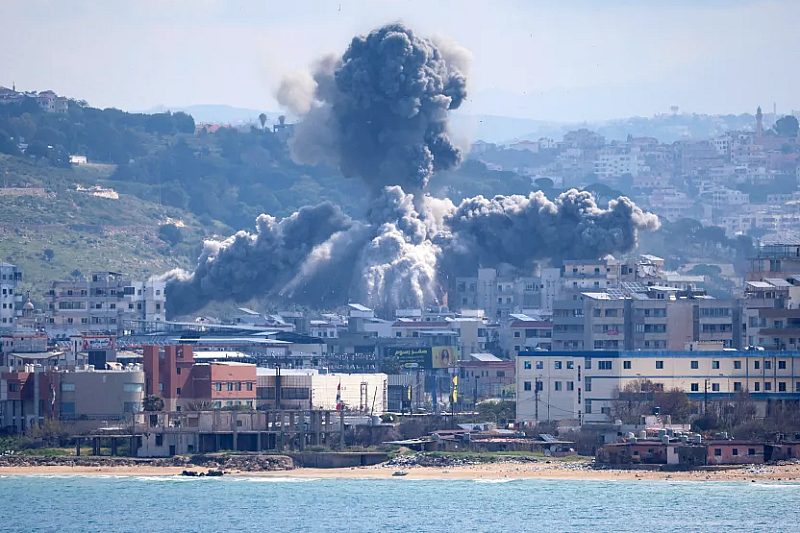
Detonations of rare violence have shaken southern Lebanon in recent weeks. According to data from Lebanon's National Center for Geophysics, the explosion of the Ali al-Taher hill, for which approximately 1,100 tons of explosives were used, generated seismic waves comparable to a magnitude 4.2 earthquake on the Richter scale. In Majdel Zoun, 80 tons of explosive charges produced vibrations equivalent to a magnitude 3.1 tremor, while another blast near the Beaufort fortress in Chaqif, involving 700 tons of TNT, shook the ground like a magnitude 3.8 earthquake, felt dozens of kilometers around.
A Dangerous Proximity to Active Faults
What particularly concerns Lebanese authorities is the location of these explosions. The Ali al-Taher site lies approximately one kilometer from the Roum fault and seven kilometers from the Yammouneh fault. As Minister El-Zein explains, "massive underground explosions can, under certain geological conditions—particularly when they occur near existing faults—cause their displacement or reactivation, which could increase the risk of seismic activity."
Specialists recall that the Roum fault has caused devastating earthquakes in the past, the most recent in 1837 reaching a magnitude of 7.1 and killing 4,000 people. For seismologist Tony Nemer, a professor at the American University of Beirut, "an explosion of such magnitude near a major fault is even more dangerous because the pressure it exerts on the fault is sudden and extremely violent."
A Risk Difficult to Measure, but Real
Experts remain cautious, however, about the probability of directly triggering an earthquake. Marlene Brax, director of the CNRS center in Bhannès, emphasizes that it is impossible to know the current stress state on the Roum fault, and therefore whether it is close to rupture. Since the Chaqif explosion, no micro-earthquakes have been detected on the fault, which is rather reassuring in the short term.
But geophysicist Ata Elias of the Lebanese University warns of another, more insidious consequence: the waves generated by these explosions propagate far underground, weakening rocks and altering topography. "The cracks and fractures created in slopes and mountains increase the risk of landslides and erosion," he explains. These effects could manifest over decades and affect infrastructure, roads, and homes.
A Diplomatic Process Underway
Faced with these threats, the Lebanese government has decided to bring the matter before international bodies. The Environment Minister has been tasked with preparing a detailed report on the consequences of these explosions, which will be transmitted to the Ministry of Foreign Affairs and then presented to the United Nations Security Council.
Tamara El-Zein stressed that these bombardments "go beyond the direct military dimension to reshape geography" and cause damage extending to the built and natural environment over a vast area. She also denounced what she describes as "ecocide," committed alongside other forms of violence suffered by Lebanon.
"The responsibility of the state requires addressing the scale of damage and risks generated by these aggressions in proportion to their gravity, and not merely documenting and enumerating war crimes," she declared. A position that reflects the growing concern of a country already severely tested, facing environmental threats whose effects could be felt long after the fighting ends.

The best of Tired Earth delivered to your inbox
Sign up for more inspiring photos, stories, and special offers from Tired Earth
By signing up for this email, you are agreeing to news, offers, and information from Tired Earth. Click here to visit our Privacy Policy.





Comment
Reply