



30 Mar 2026

Sarah Rahman
Trump's threat to destroy all of Iran's electric power plants, oil wells, and desalination plants may well awaken the dormant consciences of those who have supported him until now. But the lack of scruples is a conscious choice to betray and to officially endorse war crimes against a historic nation.
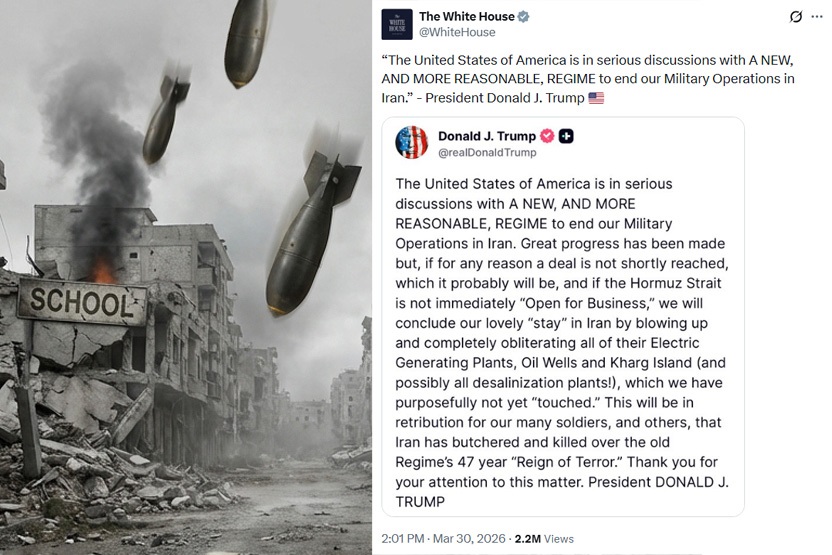
Trump’s Recent Threats Against Iran: A Journalistic and Critical Assessment
On March 30, 2026, U.S. President Donald Trump issued a stark warning on Truth Social: "If for any reason a deal is not shortly reached, which it probably will be, and if the Hormuz Strait is not immediately ‘Open for Business,’ we will conclude our lovely ‘stay’ in Iran by blowing up and completely obliterating all of their Electric Generating Plants, Oil Wells and Kharg Island (and possibly all desalinization plants!), which we have purposefully not yet ‘touched’". These threats, made amid the ongoing conflict involving Iran and Israel, go far beyond negotiation rhetoric. They explicitly target critical civilian infrastructure. A rigorous journalistic analysis must examine them through the lens of international law, their humanitarian and environmental consequences, and the deafening silence from European capitals.
A Clear Violation of International Law and Potential War Crimes
International humanitarian law (IHL), primarily codified in the 1949 Geneva Conventions and their Additional Protocol I of 1977 (reflecting customary international law even for non-parties like the United States), establishes fundamental principles: distinction between military and civilian objects, proportionality, and precaution in attack.
The threats breach these rules. Article 52 of Additional Protocol I defines a military objective as an object that, by its nature, location, purpose, or use, makes an effective contribution to military action and whose total or partial destruction, capture, or neutralization offers a definite military advantage. Threatening to destroy “all” electric power plants and “all” oil wells without distinction amounts to indiscriminate attacks, prohibited under Article 51(4). Kharg Island, Iran’s main oil export terminal, may have dual-use aspects, but its complete obliteration far exceeds any proportionate military gain.
Even more serious is the targeting of desalination plants. Article 54 of Additional Protocol I explicitly prohibits attacking, destroying, or rendering useless objects indispensable to the survival of the civilian population, including drinking water installations. In Iran, coastal desalination facilities supply a growing share of potable water in arid southern regions. Depriving civilians of water is not collateral damage — it is a method of warfare intended to starve or displace the population, qualifying as a war crime.
The Rome Statute of the International Criminal Court (Article 8(2)(b)) criminalizes attacks on civilian objects or protected property, as well as methods of warfare contrary to IHL. If carried out, these actions could also constitute crimes against humanity if they form part of a widespread or systematic attack against the civilian population. The public threats themselves, issued in the context of an armed conflict, represent a serious incitement and a violation of Article 2(4) of the UN Charter, which prohibits the threat or use of force against the territorial integrity of a state.
Bombing Oil Wells: An Environmental Catastrophe in the Making
Bombing Iranian oil wells would not be a mere military strike — it would trigger a major ecological disaster. Historical precedents are instructive. During the 1991 Gulf War, Iraqi forces set fire to over 600 Kuwaiti oil wells, releasing up to 6 million barrels per day. The consequences included massive toxic smoke plumes visible hundreds of kilometers away, oil lakes covering 200 km² of land, and a marine oil spill of 1 to 4 million barrels in the Persian Gulf. Long-term studies documented severe damage to marine sediments, wildlife, coastal ecosystems, and human health (increased cancers and respiratory diseases). Soot and CO₂ emissions locally altered regional climate, with persistent soil contamination lasting over a decade.
In the Iranian case, such an operation would cause transboundary pollution affecting the Persian Gulf, Saudi Arabia, the UAE, and Iraq. Articles 35(3) and 55 of Additional Protocol I prohibit methods of warfare that cause widespread, long-term, and severe damage to the natural environment. Systematic bombing of oil wells would clearly violate these provisions and could qualify as an environmental war crime. The economic fallout (loss of oil exports) would compound an ecological catastrophe whose costs would burden future generations.
Bombing Desalination Plants: A Direct Assault on Human Rights and a War Crime
Iran, like its Gulf neighbors, increasingly relies on desalination plants for drinking water amid chronic drought and declining groundwater. These coastal facilities serve millions. Targeting them is not a legitimate military option — it directly violates the human right to water, recognized under Article 11 of the International Covenant on Economic, Social and Cultural Rights and under IHL.
Article 54 of Additional Protocol I is unequivocal: it is forbidden to attack drinking water installations with the intent of depriving the civilian population of its supply, regardless of motive. Legal experts note that deliberate destruction of such infrastructure acts as a delayed biological weapon, leading to epidemics, dehydration, and the collapse of hospitals and sanitation systems. If executed, these strikes would constitute war crimes under the Rome Statute and grave breaches of the principles of distinction and proportionality.
Europe’s Deafening Silence: Hypocrisy Exposed
Faced with these explicit threats, the silence from European capitals is striking. The European Union, which positions itself as a champion of multilateralism, human rights, and climate action, has issued no strong, unified condemnation. Yet if these strikes occur, they would once again reveal Europe’s lack of scruples when humanitarian and ecological tragedies involve its American ally. The same passivity was observed in previous Middle East conflicts. Europe, quick to denounce Russian or Chinese violations, appears mute when Washington threatens massive destruction of civilian infrastructure. This double standard undermines the EU’s credibility and betrays its commitments under international conventions.

The best of Tired Earth delivered to your inbox
Sign up for more inspiring photos, stories, and special offers from Tired Earth
By signing up for this email, you are agreeing to news, offers, and information from Tired Earth. Click here to visit our Privacy Policy.




Comment
Reply