A critical analysis of geopolitics, athletic sovereignty, and the soul of international football

I. The World Cup and Trump's America
The FIFA World Cup is, by design, the most universal event in sport. Every four years it gathers the nations of the Earth around a shared ritual — ninety minutes of football, and the brief, improbable fiction that competition can exist in a world otherwise divided by power, ideology, and war. The 2026 edition, expanded to 48 teams and jointly hosted by the United States, Canada, and Mexico, was meant to be the grandest celebration of this fiction yet.
Instead, it has become something darker: a mirror held up to the contradictions of an America under Donald Trump, and a test of whether international sport can maintain any meaningful independence from the governments that host it.
The United States co-hosts a tournament premised on political neutrality while actively waging war against one of its participants. That paradox is not incidental; it is the defining fact of the 2026 World Cup. Long before a ball has been kicked, the tournament has been shaped less by footballing preparations than by military campaigns, presidential posts on Truth Social, and the fragile diplomatic survival instincts of FIFA's leadership.
Trump's America has always struggled with the notion that international obligations create binding duties. The decision to jointly attack Iran on 28 February 2026, while simultaneously preparing to host Iran's national football team in Los Angeles and Seattle, represents not merely a diplomatic inconsistency but a fundamental failure of the duties that accompany the privilege of hosting a global tournament. The world is watching — not the matches, not yet, but the spectacle of a host nation at war with its own guest.
II. The United States and the War in the Middle East
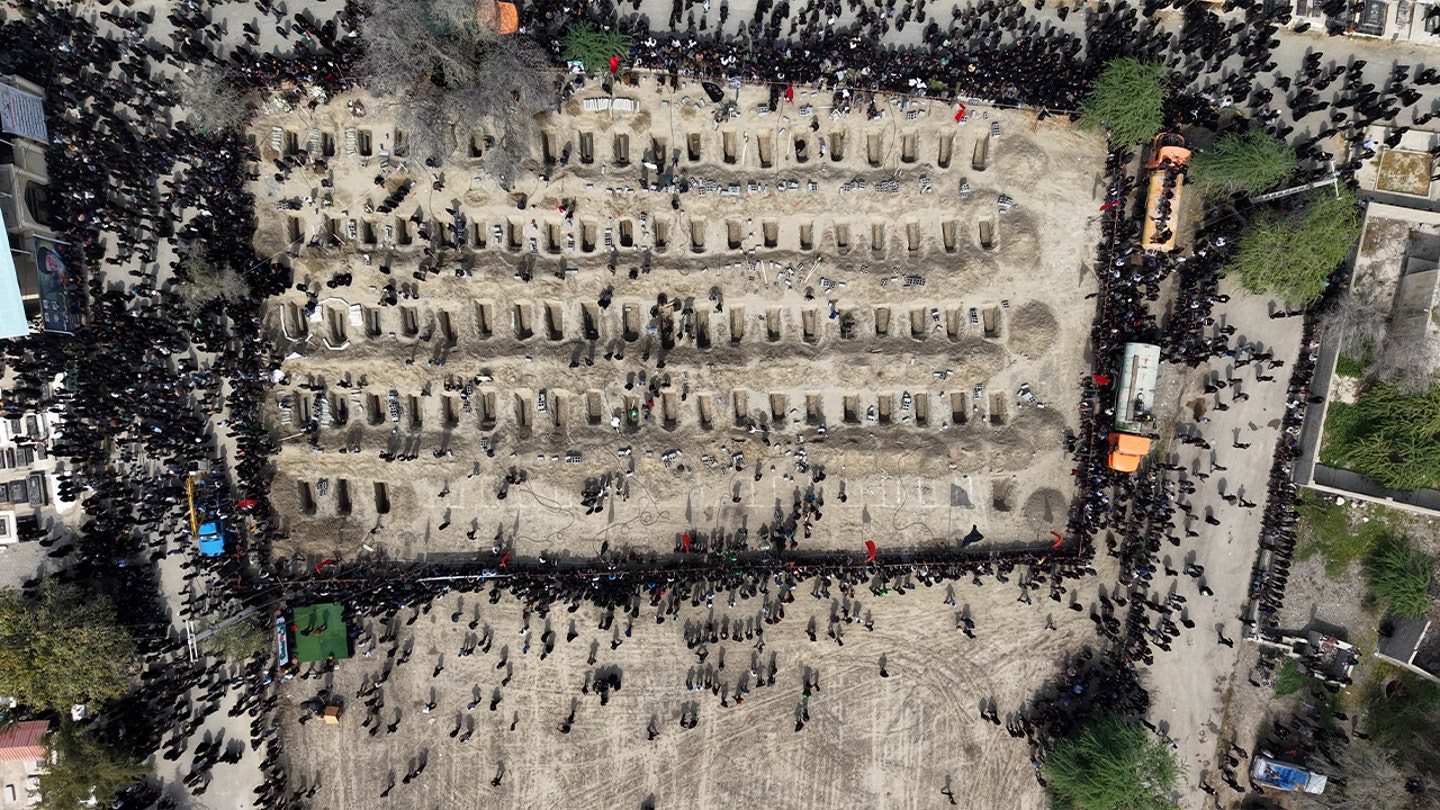
To understand the crisis around the Iranian football team, one must first understand the scale of what began on 28 February 2026. That morning, the United States and Israel launched what Britannica describes as nearly 900 strikes in 12 hours, targeting Iranian missiles, air defences, military infrastructure, and leadership. The initial wave killed Supreme Leader Ayatollah Ali Khamenei, the commander of the Iranian Revolutionary Guard Corps, and the country's defence minister. It also killed approximately 170 innocent students and teachers when a missile struck a girls' school in Minab.
An aerial view shows funerals underway at a graveyard in Minab, Iran, March 3, 2026, for students and staff from a girls school who authorities said were killed in a Feb. 28 strike. (Handout/Getty Images)
This was not a surgical strike or a limited operation. It was, by any reasonable definition, the opening of a war. Iran responded immediately, launching missiles and drones at Israel and at American military installations across Bahrain, Kuwait, Qatar, the United Arab Emirates, and Saudi Arabia. According to the Armed Conflict Location and Event Data Project (ACLED), hundreds of subsequent strikes were recorded across at least 26 of Iran's 31 provinces.
The justifications offered by Washington — that the attacks were in line with the right to self-defence under the UN Charter, and aimed at preventing nuclear proliferation — were accepted by a small handful of governments and rejected by most of the world. What is not in serious dispute is the human cost: thousands of casualties, a country under sustained bombardment, and a region pushed to the edge of generalised conflagration.
It is in this context that Donald Trump, meeting with the White House Task Force on the FIFA World Cup 2026, was asked about Iranian participation in the tournament. "I really don't care," he told Politico. "I think Iran is a very badly defeated country. They're running on fumes."
This is the attitude of a host.
III. The Threat: A Host Nation Refuses to Guarantee Security
The sequence of events that followed is, even by the standards of this era's political surrealism, remarkable.
FIFA President Gianni Infantino publicly assured the world that Trump had personally told him Iranian players would be welcomed at the tournament. Two days later, Trump took to his Truth Social platform to write: "The Iran National Football Team is welcome to The World Cup, but I really don't believe it is appropriate that they be there, for their own life and safety."
Sid Lowe, Spanish Football Correspondent for the Guardian: "The usual thing here would be for for FIFA and the host nation to reassure the participants that they will be safe. Instead, the Iran *football team* is told their life would be at threat if they come."
This statement — careful enough to avoid an outright ban, but explicit enough to constitute a threat — immediately raised the question of what "safety" meant in this context, and who, precisely, was responsible for endangering it. The answer, the world could not fail to notice, was the government of the host nation itself.
The response from Iran's football federation was swift and pointed. In a statement on their official Instagram, the team wrote: "Certainly, no one can exclude Iran's national team from the World Cup; the only country that could be excluded is one that merely carries the title of 'host' yet lacks the ability to provide security for the teams participating in this global event."
It was, among other things, an accurate description of what a host is supposed to do.
IV. Athletes' Safety Should Not Depend on the President's Whims
There is a principle at the heart of all major international sporting events: the safety of participants must be guaranteed unconditionally by the host, irrespective of the political relationships between their governments. This principle is not merely idealistic. It is codified in the legal and contractual frameworks that FIFA uses when awarding tournaments, and it is the reason that countries entering bids for the World Cup sign hosting agreements specifying their obligations to all qualified national associations.
FIFA itself was eventually forced to acknowledge the obvious. When asked about Trump's earlier suggestion that he might instruct FIFA to relocate World Cup matches from American cities he deemed unsafe, FIFA conceded that "safety and security are obviously the governments' responsibility, and they decide what is in the best interest for public safety." That statement, made in a different context, applies with equal force here. If a government cannot or will not guarantee the safety of a participating nation's delegation, it has failed a foundational obligation of the host role.
What makes Trump's intervention so troubling is not simply that it introduced uncertainty about Iranian participation — it is that the uncertainty was manufactured by the host government itself, deployed as a geopolitical instrument. The safety of twenty-three footballers and their support staff was made conditional on the diplomatic calculations of a president who, in the same breath, confessed he "really doesn't care" about their participation.
Athletes — regardless of their nationality — are not combatants. They carry passports, not rifles. The Iranian football team qualified for the 2026 World Cup through merit, through the same competitive process as every other nation. Their right to compete is not contingent on the state of relations between their government and the host country's administration. To suggest otherwise is to corrupt the foundational premise of international sport: that the field of play is a space governed by sporting rules, not by the whims of the powerful.
V. From Los Angeles to Tijuana: The Iranian Team's Forced Displacement
The practical consequences of this diplomatic climate have already been felt. Iran's football federation, originally planning to use Tucson, Arizona, as its pre-tournament base, relocated its training camp to Tijuana, Mexico. The reason, as federation president Mehdi Taj acknowledged, was to avoid complications with American visa requirements — Iranian players could reach Tijuana via direct Iran Air flights without navigating the increasingly hostile regulatory environment of direct entry into the United States.
Taj went further, formally requesting that FIFA relocate Iran's three group-stage matches — against New Zealand, Belgium, and Egypt, all scheduled in Los Angeles and Seattle — to Mexican venues. FIFA's initial response was to decline or defer. The federation was not deterred; by late April, Iran was still pressing for the transfer, with Sports Minister Ahmad Donyamali declaring that the possibility of his country's participation in US venues was "very low" without ironclad security guarantees.
The Iranian federation presented FIFA with an ultimatum: guarantees on visas for all squad members, assurances of respect for the Iranian flag and national anthem, security protection for the delegation, and freedom of movement between venues. Taj put the situation plainly: "We are going to the World Cup, for which we qualified, and our host is FIFA — not Mr. Trump or America."
That sentence encapsulates the absurdity of the situation. A national football team should never need to remind a host nation that their real guarantor is the sport's governing body. And yet FIFA — whose president maintains what observers have charitably described as a "close relationship" with Trump — has found itself caught between its contractual obligations to Iran and its practical dependency on the goodwill of the United States government.
As of the time of writing, Iran remains in a fragile ceasefire with the United States. Their participation in the World Cup remains formally uncertain. Their players train in a Mexican border city, one step removed from the tournament they earned the right to attend.
VI. The History of World Cups and War
The 2026 crisis is unprecedented in important ways — no host nation has previously been at active war with a participating team — but the intersection of football's grandest tournament with the violence of the real world is a recurring, uncomfortable theme in the competition's history.
The most instructive precedent is the 1982 World Cup in Spain, played in the shadow of the Falklands War. Argentina had invaded the British-held islands in April of that year; the conflict cost more than 900 lives on both sides. Two months later, both England and Argentina competed in the same tournament on Spanish soil. The British government, led by Margaret Thatcher, seriously contemplated withdrawing all home nations from the competition — official documents later revealed that the sports minister issued directives urging "no sporting contact with Argentina at representative, club or individual level." It was an effort that ultimately failed. The home nations competed. Football, improbably, continued alongside war.
Four years after the Falklands, England met Argentina in the World Cup quarter-final in Mexico. Diego Maradona later said the Argentine players thought about the boys who had died, "shot down like little birds," as they prepared for the match. The game produced both his most transcendent moment and his most notorious act. Football and geopolitics fused in ninety minutes of extraordinary drama.
The 1978 World Cup, hosted by Argentina under a military dictatorship, offered a grimmer lesson: that sport can be bent into the service of power, providing a veneer of international legitimacy for regimes that deserve none. The junta's propaganda victory in hosting and winning the tournament was, by most historical accounts, precisely what the generals intended.
These precedents suggest something important: sport has never successfully insulated itself from politics, only occasionally managed to transcend it. What the 2026 situation represents is a new and more disturbing variant — not the old problem of a repressive host exploiting the tournament for prestige, but the novel problem of a host nation using the machinery of a sporting event as a weapon in an active military conflict.
The 1982 Falklands crisis produced difficult political pressure on athletes who ultimately competed. The 2026 Iran crisis has produced something more corrosive: a systematic doubt, instilled by the host government itself, about whether a qualified nation's athletes will be physically safe on the host's soil. The line between diplomatic pressure and security threat has been deliberately blurred.
VII. Conclusion: Football Cannot Survive as a Tool of War
The 2026 FIFA World Cup begins on 11 June. Whether Iran's players take the field in Los Angeles or in a relocated Mexican venue, or do not take the field at all, the damage to the idea of an international sporting festival has already been done.
What this crisis exposes is not merely a geopolitical dispute — it is a structural failure. FIFA has built its billion-dollar empire on the promise that football transcends borders, that the tournament belongs to the world, that the universal language of the game overrides the particular interests of states. That promise has been tested many times, and often found wanting. But it has rarely been tested quite so directly: a host nation waging war against a participant and then offering something between a warning and a threat about that participant's safety on its soil.
The principle that must be defended — not by Gianni Infantino's careful diplomacy, but by sports governance institutions with genuine independence and enforcement powers — is simple: athletes are not combatants. The football pitch is not an extension of the battlefield. The qualification for a World Cup confers a right to compete that no government should have the unilateral power to revoke or endanger.
Trump's intervention in the Iranian football team's participation — the Truth Social post, the "I really don't care," — was not an expression of concern for Iranian players' wellbeing. It was political theatre, a continuation of the war through other means. The athletes caught in its crossfire are, as they have so often been throughout history, people of exceptional skill and dedication who simply wish to play football, and who find themselves conscripted, unwillingly, into a conflict they did not choose.
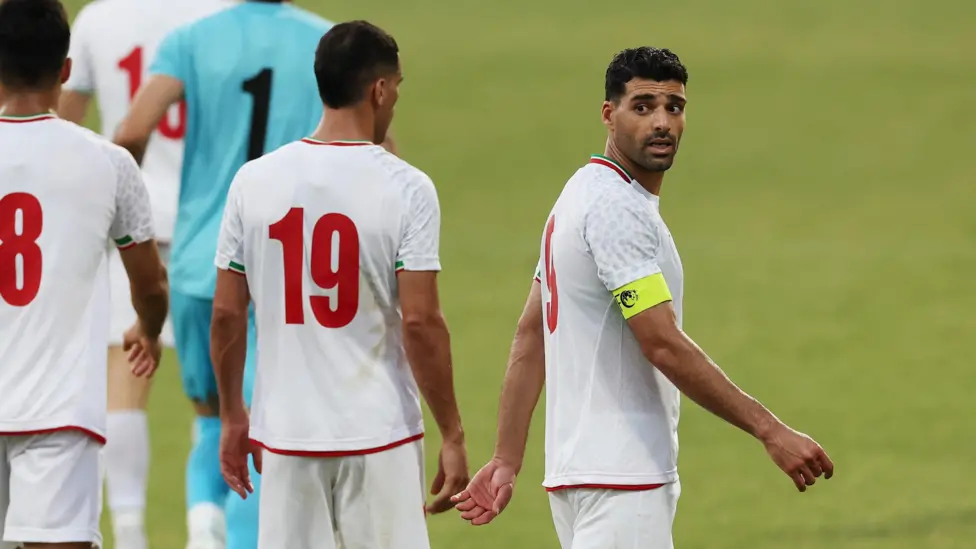
Mehdi Taremi was directly involved in 49% of Iran's goals in the qualifiers for the 2026 World Cup – he scored 10 and assisted seven of Iran's 35 goals (BBC)
Sport will not save the world. It never has. But it owes the world, at minimum, an honest refusal to become an instrument of the forces that endanger it. That refusal requires institutions strong enough to tell even the most powerful host nation: the safety of every team is non-negotiable. It requires rules with consequences, not merely statements of principle. And it requires the political will to enforce them — something that, as the 2026 World Cup approaches, remains conspicuously, dangerously absent.
The ball cannot play in the shadow of the bomb. Not without consequence. Not without complicity.
This article is based on verified reporting and publicly available information as of June 2026.










Comment
Reply