



29 Apr 2026

Tired Earth
By The Editorial Board
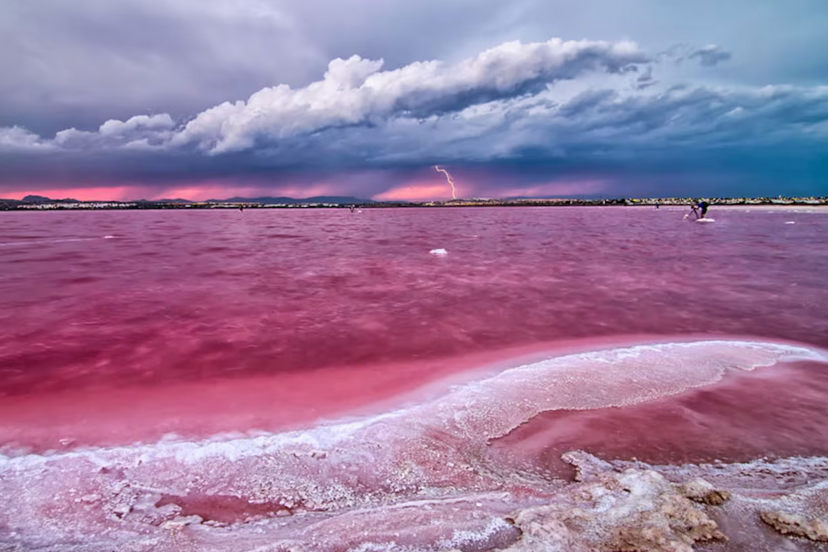
Lake Maharloo, also known as the Pink Lake near Shiraz in Iran, has been revitalized by recent rainfall, bringing its waters back to life
In recent days, remarks by Dr. Fatima Saad Al-Hasani, a faculty member at the University of Oregon, have attracted significant attention. In a statement that has circulated widely across media and analytical platforms, she suggested that the targeting of a technical facility in the United Arab Emirates on April 13, 2026, was “not merely a military attack,” but could also be viewed as a disruption of a broader “climate system.” According to her, the facility was part of infrastructure linked to weather modification and precipitation management efforts in the region.
She further indicated that the site may have played a role not only in the UAE’s cloud seeding programs but also in influencing weather patterns in Iraq and eastern Iran within a wider operational network. Following the reported cessation of the facility’s activities, observers have pointed to sudden shifts in regional weather conditions, including increased rainfall, a relative drop in temperatures, and the reappearance of humidity patterns in parts of Iran and Iraq. In some interpretations, these developments have been framed as possible evidence of “climate intervention.”
 When Iran attacked a secret cloud-seeding and weather control center in the UAE it[...]_1777447923.png)
Photos circulating on social media show a striking comparison of a river in Sulaymaniyah, Iraq—once dry last year and now flowing again after recent rains.
These assertions emerge within a broader and long-standing debate about weather modification technologies. Techniques such as cloud seeding—and, more controversially, large-scale atmospheric interventions—have been discussed for decades in both scientific and public spheres. While such technologies are used in limited and controlled contexts, the broader concept of climate geoengineering remains highly contested. Questions persist about its effectiveness, unintended consequences, and the absence of clear international regulatory frameworks. Crucially, there is no scientific consensus supporting the idea that existing technologies can produce large-scale, cross-border climatic changes of the magnitude described in some narratives.
At the same time, the sensitivity of issues related to water security and climate stress—especially in arid and semi-arid regions—creates fertile ground for speculation and competing interpretations. Some analyses have gone further, suggesting both declared and undeclared objectives behind such technologies. These range from increasing rainfall in specific countries to potentially altering moisture flows in neighboring regions, with possible impacts on agriculture and water resources.
References have also been made to substances such as silver iodide or aluminum compounds, which are indeed used in certain cloud seeding operations. However, the broader capabilities attributed to these materials—such as the ability to dry vast territories or fundamentally alter regional wind systems—remain scientifically unproven and widely disputed.
Additional claims have surfaced about the possible reconstruction or relocation of such infrastructure, including the use of drones instead of fixed ground installations, as well as alleged involvement by other states in developing related technologies.
Taken together, these narratives highlight a complex intersection of science, geopolitics, and public perception. They raise important questions about the real capabilities of weather modification technologies and their potential implications for regional climate and water security. Addressing these questions requires rigorous scientific investigation, transparent data, and meaningful international oversight.
In the absence of such transparency, interpretations can quickly expand into broader and more contentious narratives. For this reason, many in the scientific community stress the importance of cooperation, open data sharing, and evidence-based analysis. Climate systems underpin human societies, and any misunderstanding—or misrepresentation—of how they function carries risks that extend far beyond political or national boundaries.

The best of Tired Earth delivered to your inbox
Sign up for more inspiring photos, stories, and special offers from Tired Earth
By signing up for this email, you are agreeing to news, offers, and information from Tired Earth. Click here to visit our Privacy Policy.


Comment
Reply